
Financial ROI Analysis of VR Occupational Safety and Health Training

This study analyzes the return on investment (ROI) of virtual reality (VR) occupational safety training applied in industrial production facilities and heavy industry, compares its costs with traditional training models, and financially evaluates its impact on operational efficiency.
What are the hidden costs of traditional occupational safety and health (OSH) training?
Traditional occupational health and safety training in industrial facilities carries hidden costs far beyond the immediately apparent budgets:
- Production Line Downtime: Stopping machines or disrupting shift schedules to allow personnel to receive practical training leads to production losses.
- Operational and Logistics Costs: Classroom training, instructor fees, printed materials, travel, and accommodation expenses are recurring costs each year.
- Error and Accident Costs: Workplace accidents caused by insufficient practical training have very heavy direct (treatment, compensation) and indirect (legal processes, loss of brand image, equipment damage) financial burdens.
How is the Return on Investment (ROI) calculated in VR Occupational Safety and Health (OSH) Training?
VR (Virtual Occupational Safety and Health) training’s financial return is calculated by comparing the one-time technology investment with recurring operational savings. The mathematical ROI formula is as follows:
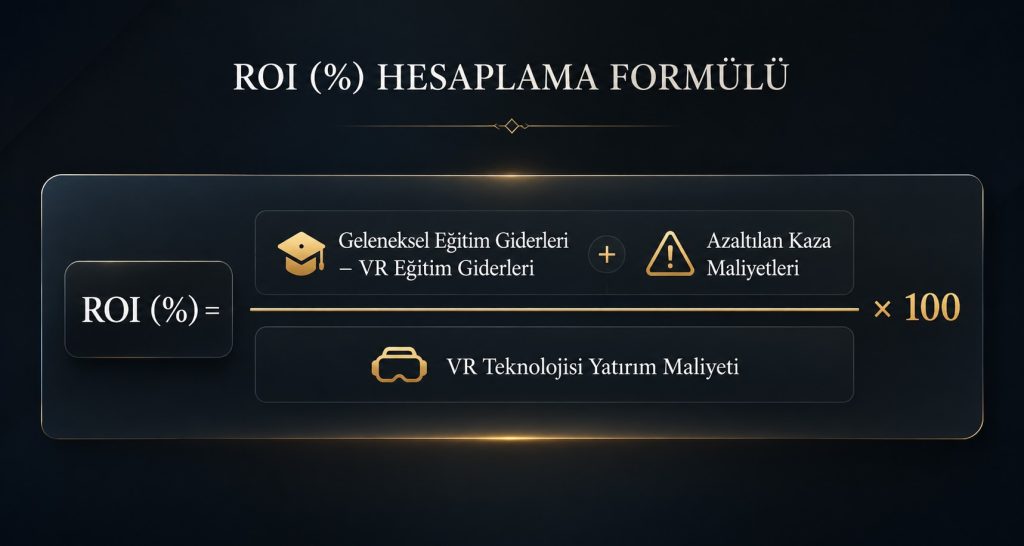
- Initial Investment Cost (CapEx): Includes the procurement of standalone VR headsets and the development of the C#-based custom simulation engine software (VR HSE).
- Operating Expenses (OpEx): Since VR systems do not require logistics, consumables, or classroom setup, recurring operating expenses are close to zero. Savings in the operational budget begin from the first year.
How Can Virtual Reality (VR) Training Increase Operational Efficiency?
VR training technologies optimize operational processes by transforming theoretical knowledge into muscle memory and practical reflexes:
- 60% Reduction in Training Time: Hazard awareness training, which takes 4 hours with traditional methods, is completed in 45 minutes to 1 hour with VR simulations. This shortens the time it takes for personnel to go to the field. 80%
- Higher Retention: Thanks to the learning-by-doing model, response times to emergency scenarios are improved, and information retention is 80% higher compared to traditional classrooms.
- Faster Orientation: The adaptation period of new employees to the factory culture and HSE rules is shortened, and the transition to increased work efficiency is accelerated.


